
Best Gaming Monitor for PS5 in 2026
Discover the best gaming monitors for PS5 with high refresh rates, low input lag, and stunning visuals.
Why Curved Monitors Feel More Immersive
Human vision is naturally curved. When a screen matches that curvature, it reduces distortion and keeps edges within your peripheral vision.
Benefits include:
Wider perceived field of view
Less edge stretching
More natural depth perception
Increased focus during gameplay
Reduced eye movement across screen
For open-world games, racing simulators, and RPGs, immersion improves significantly.
Best Curved Monitor for Gaming: Core Features That Matter
When evaluating the best curved monitor for gaming, focus on four primary factors:
Resolution
Refresh rate
Response time
Panel type
These determine clarity, smoothness, and responsiveness.
Resolution: 1440p vs 4K Curved Gaming Monitors
Resolution directly affects visual detail.
1440p Curved Gaming Monitors
Easier to run at high FPS
Ideal for 27–32 inches
Excellent balance of clarity and performance
Best 4K Curved Gaming Monitor Options
Maximum detail and sharpness
Best for large screens (32″+)
Demands powerful GPU
If you want cinematic visuals and future-proofing, the best curved gaming monitor 4K models deliver unmatched clarity.
Refresh Rate: Smoothness and Competitive Advantage
Refresh rate determines motion fluidity.
60Hz → Basic gaming
120–144Hz → Smooth gaming
165Hz+ → Competitive gaming
240Hz → Esports level
For FPS and fast action titles, high refresh rate matters more than resolution.
Response Time and Motion Clarity
Response time measures how fast pixels change color.
Look for:
1ms–3ms for competitive gaming
Low motion blur
Minimal ghosting
Curved monitors designed for gaming usually optimize motion clarity for fast scenes.
Panel Types in Curved Gaming Monitors
Panel technology affects contrast, color, and speed.
VA Panels
Deep blacks
High contrast
Common in curved displays
Great for immersive gaming
IPS Panels
Accurate colors
Better viewing angles
Balanced gaming performance
OLED Panels
Perfect blacks
Instant response
Premium pricing
Many of the best curved gaming monitors use VA for immersion and IPS for color precision.
Screen Size and Curvature: Finding the Sweet Spot
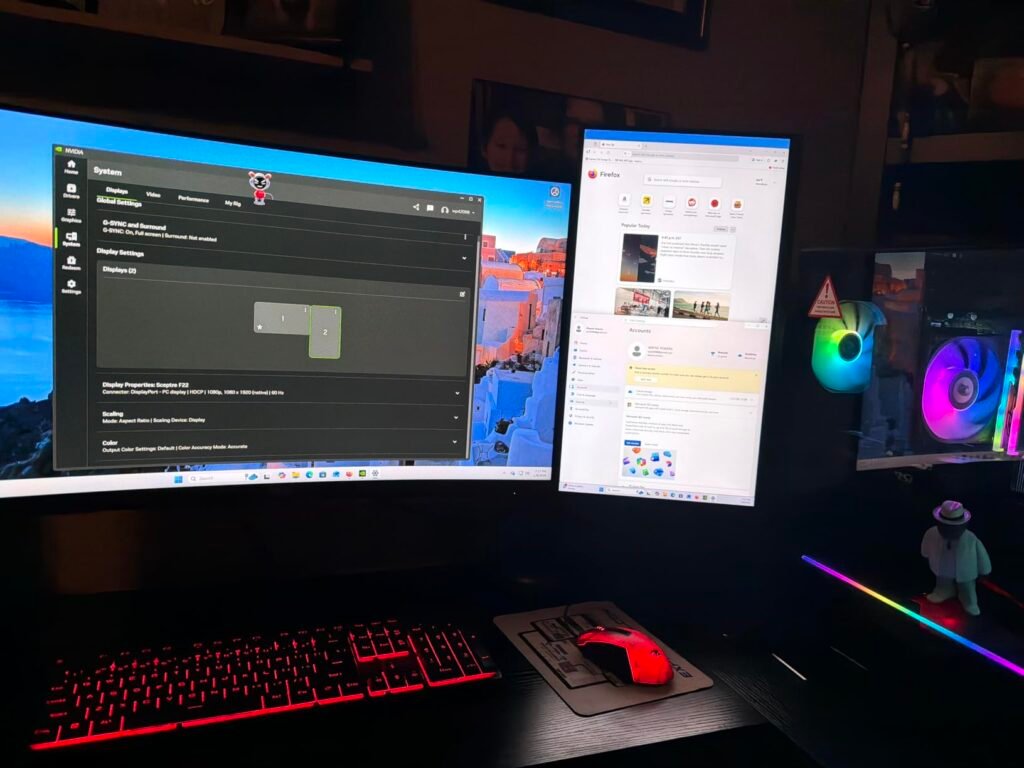
Curved monitors vary widely in size and curvature.
Recommended Sizes:
27″ → Competitive gaming
32″ → Balanced immersion
34″ ultrawide → Cinematic gaming
49″ super ultrawide → Maximum immersion
Curvature Ratings:
1000R → Deep immersion
1500R → Balanced curve
1800R → Subtle curve
A deeper curve enhances immersion on larger screens.
Best Curved Gaming Monitor 4K: Who Should Choose It?
A 4K curved gaming monitor is ideal if you:
Play AAA single-player titles
Value visual realism
Use high-end GPU hardware
Want both gaming and productivity
For cinematic experiences, the best curved gaming monitor 4K options excel.
Ultrawide Curved Monitors: Expanding the Game World
Ultrawide curved displays expand horizontal field of view.
Advantages:
More game environment visible
Improved situational awareness
Better immersion in racing & simulation
Multi-tasking productivity
Many gamers consider ultrawide the ultimate immersive format.
Adaptive Sync: Eliminating Screen Tearing
Modern gaming monitors include:
NVIDIA G-Sync
AMD FreeSync
These technologies synchronize refresh rate with GPU output to eliminate:
Screen tearing
Stuttering
Frame pacing issues
The best curved gaming monitors always support adaptive sync.
HDR and Contrast Performance
High Dynamic Range improves brightness and contrast.
Look for:
HDR600 or higher
Strong peak brightness
Local dimming capability
True HDR dramatically enhances lighting effects in games.
Console Gaming on Curved Monitors
Curved monitors can work well with consoles if they support:
HDMI 2.1
4K 120Hz
VRR
Next-gen consoles benefit from curved displays when properly supported.
Desk Setup and Ergonomics
Curved monitors require correct placement.
Tips:
Center at eye level
Sit within curve radius
Use adjustable stand or arm
Maintain proper viewing distance
Correct ergonomics maximize immersion and comfort.
Best Curved Gaming Monitors for Different Gamers
Competitive FPS Players
24–27″
144Hz–240Hz
1080p or 1440p
Immersive AAA Players
32″ or ultrawide
4K resolution
HDR support
Simulation & Racing Fans
Ultrawide curved
1000R curvature
High refresh rate
Matching monitor type to game genre improves experience.
Pros and Cons of Curved Gaming Monitors
Pros
Enhanced immersion
Reduced edge distortion
Better wide-screen viewing
Stylish gaming setups
Cons
Higher cost
Less ideal for shared viewing
Larger desk footprint
Understanding trade-offs helps with realistic expectations.
Frequently Asked Questions
Is a curved monitor better for gaming?
Yes, especially for immersive and wide-field games.
What is the best curved gaming monitor 4K size?
32 inches or larger is ideal for 4K clarity.
Are curved monitors good for competitive gaming?
Yes, particularly high refresh rate models.
Do curved monitors reduce eye strain?
They can reduce eye movement across wide displays.
Is ultrawide better than 4K?
Ultrawide increases immersion; 4K increases detail.
Curved Gaming Monitor Psychology: Why Immersion Feels Stronger
One reason gamers prefer the best curved gaming monitor is psychological immersion. When the display wraps around your peripheral vision, your brain interprets the image as more “environmental” rather than “flat.”
This effect is especially noticeable in:
Open-world RPGs
Racing simulations
Flight simulators
First-person exploration games
A curved display reduces awareness of screen edges, helping players feel inside the game world rather than looking at it.
Field of View Advantage in Gaming
Curved displays don’t increase actual in-game field of view (FOV), but they change perceived FOV.
Because edges angle toward your eyes:
Peripheral details feel closer
Side motion feels more natural
Spatial awareness improves
Eye refocusing distance decreases
This is why many consider the best curved monitor for gaming superior for immersion-heavy genres.
Viewing Geometry: Why Curvature Matters
Curved monitors are designed so every point on the screen stays roughly equal distance from your eyes.
Flat monitors cause:
Edge distortion
Slight focus shifts
Peripheral blur
Curved panels reduce these issues, particularly on larger displays (32″+).
That’s why the best curved gaming monitors are most beneficial at larger sizes.
1000R vs 1500R vs 1800R: Real-World Differences
Curvature ratings describe the radius of the circle the screen would form.
1000R: Very immersive, wraps around vision
1500R: Balanced immersion and usability
1800R: Gentle curve
For competitive desk gaming:
1000R → maximum immersion
1500R → most versatile
1800R → subtle comfort
The best curved gaming monitor 4K models often use 1000R or 1500R.
Contrast Depth: Why Curved VA Panels Look Cinematic
Most curved gaming monitors use VA panels because they provide:
High contrast ratios
Deep blacks
Strong shadow detail
Rich nighttime scenes
This makes VA curved displays excellent for:
Horror games
Space games
Cinematic titles
Dark environments
IPS panels provide better color accuracy, but VA panels often deliver more dramatic contrast.
Motion Perception on Curved Displays
Curved monitors can make motion feel smoother even at the same refresh rate.
Reasons include:
Peripheral alignment with eye movement
Reduced edge motion distortion
More natural horizontal tracking
This is particularly noticeable in:
Racing games
Flight simulators
Fast camera panning scenes
While refresh rate still dominates motion clarity, curvature enhances perceived smoothness.
Desk Depth and Optimal Viewing Distance
Curved monitors require proper distance for best effect.
Recommended Distances:
27″ curved → ~70–90 cm
32″ curved → ~80–100 cm
34″ ultrawide → ~90–110 cm
Too close reduces immersion.
Too far reduces curvature benefit.
Positioning matters as much as monitor choice.
Ultrawide Curved Monitors: Peripheral Gaming Advantage
Ultrawide curved displays expand horizontal space.
Benefits include:
Wider environment visibility
Less camera panning needed
Better situational awareness
Natural cockpit-style view
For racing, flight, and simulation genres, ultrawide curved monitors often provide the most immersive experience available outside VR.
4K Curved Gaming Monitor: When Resolution Wins
The best curved gaming monitor 4K models excel when:
Screen size is 32″ or larger
Viewing distance is moderate
GPU supports high resolution
Game textures are detailed
4K curved displays shine in:
Story-driven games
Cinematic titles
RPG worlds
Open-world exploration
If visual realism matters more than competitive speed, 4K curved monitors lead.
Competitive Gaming Trade-Off: Speed vs Immersion
Competitive players prioritize:
High refresh rate
Low latency
Fast response
Immersion-focused players prioritize:
Screen size
Curvature
Resolution
HDR
The best curved monitor for gaming depends on which side you fall on.
HDR and Lighting Realism in Curved Displays
HDR enhances:
Bright highlights
Deep shadows
Realistic lighting
Atmospheric effects
Curved HDR monitors amplify realism because lighting wraps around your visual field.
True HDR curved monitors require:
High peak brightness
Local dimming
Wide color gamut
Basic HDR labels often provide limited benefit.
Eye Comfort During Long Gaming Sessions
Curved monitors may reduce eye fatigue because:
Edges remain in natural focus
Less eye refocusing required
More uniform viewing distance
Reduced peripheral strain
For long sessions, many gamers report greater comfort with curved displays.
Future Trends in Curved Gaming Monitors
The curved monitor market continues evolving.
Emerging trends include:
OLED curved panels
Higher refresh 4K (240Hz)
Mini-LED backlighting
Wider ultrawide formats
HDR1000+ brightness
Future curved monitors aim to combine immersion, speed, and color precision.
Common Misconceptions About Curved Monitors
Myth: Curved monitors are only aesthetic
→ Reality: They improve immersion and viewing geometry
Myth: Curved monitors distort images
→ Reality: Proper viewing distance eliminates distortion
Myth: Curved is bad for competitive gaming
→ Reality: High-refresh curved monitors perform equally well
Understanding these myths helps buyers choose confidently.
Frequently Asked Questions (Additional)
Is curved or flat better for gaming?
Curved is better for immersion; flat may suit multi-viewer setups.
Is 32″ curved too big for gaming?
No — it’s ideal for 1440p or 4K immersive gaming.
Do pro gamers use curved monitors?
Some do, especially in simulation and immersive genres.
Is ultrawide curved worth it?
Yes, for immersion and peripheral awareness.
Does curvature matter at 27″?
Less than at larger sizes, but still noticeable.
Final Extended Conclusion
The best curved gaming monitor delivers more than just a stylish screen — it enhances immersion, comfort, and visual depth. Whether you’re searching for the best curved monitor for gaming performance, exploring the best 4K curved gaming monitor for cinematic realism, or comparing multiple best curved gaming monitors, the right choice depends on how you play.
For competitive speed, prioritize refresh rate and response.
For immersive realism, prioritize size, curvature, and resolution.
As gaming visuals continue advancing, curved monitors remain one of the most impactful upgrades for a truly enveloping experience.